Put WordPress data — the post’s title and date, the author, custom and ACF fields, the visitor’s name, the current year — into any text, link, image or setting, with a fallback for empty values.
Dynamic data is written as a token inside ordinary text: Written by {author_name} on {post_date:F j, Y}. When the page is shown, Native AI replaces each token with its value. Tokens work in any text, link, image, HTML attribute and background, and in form fields, menu labels and conditions.
{name} — a value, like {post_title}.
{name:argument} — with an argument, like a date format or a field name: {custom_field:city_name}.
{name|fallback} — with text to show when the value is empty: {custom_field:city_name|our city}.
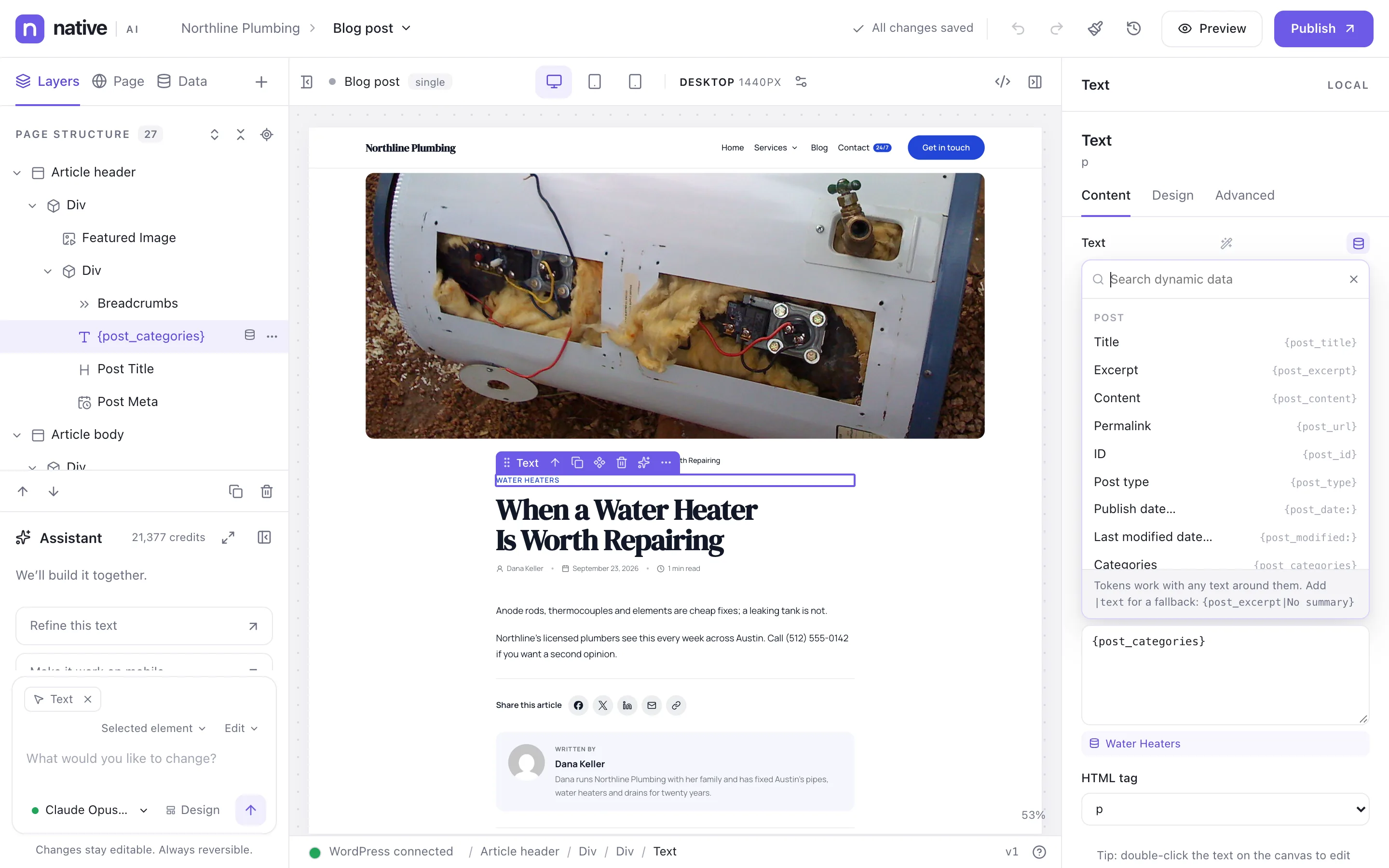
You don’t have to type them: every field that accepts dynamic data has a picker next to it, grouped and searchable, that asks for the argument and the fallback and shows a live preview. The canvas shows real values from a preview post, so templates look like the real thing while you design.
northline-plumbing.example/?nativeai=edit
The dynamic data picker: post, author, site and custom fields.
Inside a Query Loop, post tokens show each result’s own data. In a template, they show the post, term or author being viewed. {item:…} reads the current record of a loop over external data, and {api:@source.path} reads a data source anywhere on a page.
Custom fields and Advanced Custom Fields (when ACF is active) appear in the picker with their labels; ACF images and links have their own tokens.
Private fields (names starting with _) and fields that look like credentials are hidden. Settings → Dynamic data → Always allow these custom fields makes exceptions; Never show these custom fields hides more.
Settings → Dynamic data → Advanced Custom Fields turns ACF support off.
Values are escaped for where they go: plain text in text, safe URLs in links (anything unsafe becomes #), validated values in styles. In the builder, custom fields are only previewed for posts you can edit.